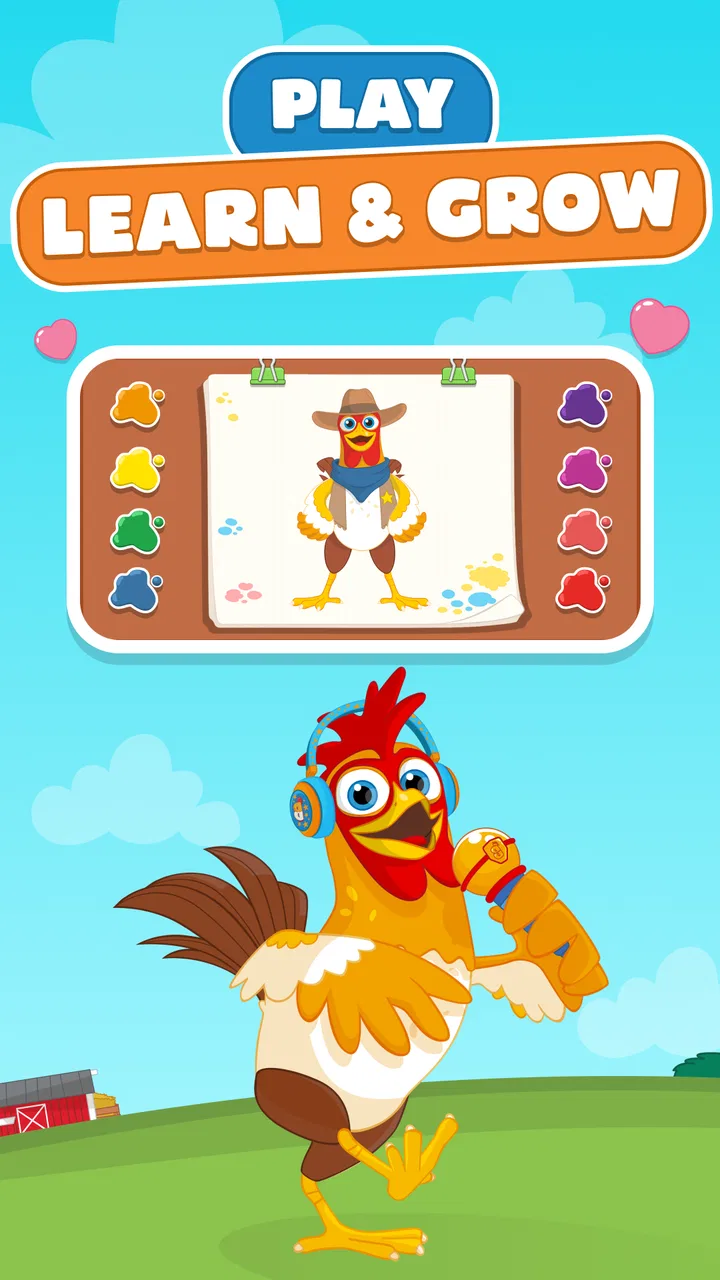
Bartolito Play & Learn
- 0.0
- Rating
- 10.00K
- Installs
- Free
- Price

 Analysis by App-foxy
When I first opened Bartolito Play & Learn, I understood its appeal quickly: it is a small educational game built around the familiar world of Bartolito and La Granja de Zenón, with music, play, and early learning placed together instead of treated as separate activities. The store summary captures that combination with its invitation to play, sing, and learn, but the more useful question for a parent is whether a child can understand what to do without constant adult help.
My impression is that this is best approached as a short, guided play session rather than a complete learning curriculum. It feels suited to children who respond to recognizable characters, songs, and repetition. It may also work well as a gentle first game for a child who is not yet comfortable with more complex menus or competitive challenges. The experience is free to start, carries an Everyone age rating, and comes from Puro Digital and Studio SL.
The game is listed in the Educational category, which is a reasonable description, although I would not treat the label as a promise that it replaces reading practice, structured lessons, or hands-on play. Its value is more focused: it can turn a few spare minutes into a familiar, cheerful activity where a child interacts with a favorite farm character while practicing attention and recognition.
You May Also Like

 AccuWeather: Weather Radar
AccuWeather Review: A Quick, Clear Forecast for Everyday Decisions
For everyday plans, the best forecast is the one you can understand quickly. AccuWeather makes rain timing, radar, and local conditions easy to act on, with a few trade-offs.

 Hill Climb Racing
Why Hill Climb Racing Still Turns Crashes Into One More Run
A tiny car, a bumpy hill and one more upgrade: Hill Climb Racing keeps resurfacing because its simple chaos makes every near-miss feel personal.

 AliExpress - Shopping App
AliExpress Makes Global Shopping Feel Personal, but Shoppers Bear the Risk
AliExpress turns a global marketplace into a pocket-sized discovery engine. Its reach is useful, its shopping loop compelling, and its trade-offs easy to miss.

 Lords Mobile: Kingdom Wars
Lords Mobile Is a Kingdom-Building Routine, Not a Quick Match
A case-by-case verdict on the building, battles, device demands, and social commitments that make Lords Mobile rewarding for some players and exhausting for others.

 PDF Scanner app - TapScanner
TapScanner Makes Paperwork Easier to Capture, Check, and Share
TapScanner makes scanning with a phone feel less like a rescue operation and more like a dependable step in getting work done. Its capture tools are useful, though not flawless.

 Block Blast!
 Shows How Much a Puzzle Game Can Leave Out
A quiet grid game shows why puzzle players increasingly value instant clarity, repeatable skill and low-pressure play—and where the genre still needs to catch up.
More From Our News Desk
View All News


What to expect from the first session
A first-time user should expect a character-led experience rather than a conventional action game. The central attraction is the combination of Bartolito, singing, and simple learning moments. That matters because young children often engage more readily with a known voice or character than with an abstract educational exercise. The theme gives the activity an emotional starting point before the child has learned the controls.
I would begin with modest expectations. This is not the kind of title I would choose for a child who wants a long adventure, deep progression, or a large collection of competitive mini-games. It is more appropriate for brief sessions that can be repeated. Repetition is not automatically a weakness in an early-learning game: a child may need to hear, see, and perform a familiar action several times before it becomes comfortable.
The current release is version 0.1.3, so I would also regard it as an early-stage product. That does not make it unusable, but it does affect how I judge it. I look for a clear first interaction and a pleasant rhythm rather than expecting the breadth of a mature educational platform. If your priority is a large library of subjects, detailed progress reports, or extensive parental controls, a more established learning app may be a better fit.
The free entry point is helpful for families who want to try the experience before committing. At the same time, the presence of in-app purchases ranging from four dollars and ninety-nine cents to fifty-nine dollars and ninety-nine cents per item means I would supervise the first setup and any purchasing screen. A child should be able to enjoy the initial experience without being left to interpret payment choices alone.
Who is likely to enjoy it
I see the strongest match for preschool-age children and young learners who already recognize Bartolito or the wider La Granja de Zenón setting. Familiarity can reduce the hesitation that often appears when a child opens an unfamiliar educational app. A child who likes to sing along, repeat sounds, or tap through simple activities is more likely to stay engaged than one who expects a fast, reward-heavy game.
It can also suit a parent looking for a transition activity. For example, after breakfast, I might use it for a short session before getting ready for school, with the child completing one activity and then putting the device away. The musical theme makes that routine feel less like a worksheet, while the limited session can prevent the game from taking over the morning.
I would skip it if the child is looking for open-ended building, a story with many chapters, or a demanding puzzle challenge. I would also choose a different option for older children who need spelling, arithmetic, or reading exercises matched to a specific school level. The farm setting may be inviting, but the theme alone does not make every activity appropriate for every learner.
Getting started without unnecessary friction
My advice is to set up the game yourself before handing the device over. That simple step lets you see where the child is likely to tap, understand how the first activity begins, and notice where purchase prompts may appear. It also gives you a chance to adjust the volume to a comfortable level, especially if the child will be using the app in a shared room or during a quiet routine.
The minimum operating system is Android 7.1, so compatibility should be checked on the intended device before planning a session. The game is free to install, but I would still avoid treating installation as the end of the adult’s role. Young users can move quickly through colorful screens, and a one-minute preview by a parent is often enough to make the first experience calmer.
When I introduce an app like this, I avoid explaining every possible action in advance. Too much instruction can make a simple activity feel like a lesson before the child has touched it. Instead, I would say something specific and reassuring: “Let’s find Bartolito, listen carefully, and try one thing together.” That gives the child a manageable goal without turning the opening into a test.
A useful setup habit is to choose a moment when the child is alert but not already frustrated. If the child is hungry, tired, or rushing to another activity, even a well-designed game can appear confusing. The first session should be treated as exploration, not as a measurement of ability. I would give the child time to observe the screen, listen to the music, and make an initial mistake without immediately taking the device back.
Finding the first meaningful success
The first success should be small and visible. I would look for the moment when the child recognizes what the screen is asking, performs the action, and understands that the response came from their own choice. In a character-based educational game, that moment may be less about completing a difficult challenge and more about connecting a sound, image, or instruction with the correct tap.
To make that happen, I would sit beside the child for the opening round and use a three-step rhythm: watch once, try together, then try alone. Watching prevents the child from feeling lost; trying together reduces hesitation; trying alone shows whether the interaction has actually made sense. If the child succeeds, I would ask them to explain what they did rather than immediately moving to the next screen.
This is one of the less obvious strengths of a music-centered learning game. Singing or repeating an action can give a child a way to participate even before they can describe the underlying lesson. I would listen for whether the child begins anticipating a sound or responding to a familiar cue. That kind of anticipation is a more useful sign of engagement than simply tapping rapidly through the interface.
Parents can turn the first success into a short offline activity. If the game introduces a farm-related sound, character, or repeated phrase, pause afterward and ask the child to imitate it, draw it, or find something similar in the room. This keeps the app from becoming an isolated screen habit and helps transfer the playful recognition into conversation and memory.
Where a child may become confused
The most likely confusion is not necessarily the learning content; it is the difference between decorative elements and interactive ones. Young children often tap every character, picture, or button that catches their eye. I would not correct every exploratory tap. Instead, I would help them notice which response changes the activity and explain that some parts are there to watch or listen to while others invite an action.
Another common problem is assuming that louder or faster tapping will produce a better result. If the child starts tapping repeatedly, I would slow the session down and model one deliberate choice. The goal is to teach attention to the cue, not speed. This is especially important in a musical setting, where the child may become excited and focus more on rhythm than on the learning prompt.
Parents should also be ready for a child to request the same favorite moment repeatedly. That repetition can be valuable, but unlimited replay may reduce the educational challenge to passive watching. My approach would be to allow a few repeats, then add a tiny variation: ask the child to predict what comes next, name the character, or perform the action before the screen does it. If the child loses interest, I would end the session rather than force a lesson.
Payment screens are another reason for adult supervision. Because individual in-app purchases can reach fifty-nine dollars and ninety-nine cents, I would not leave a young child alone with the device during the first exploration. The free starting point makes trying the game straightforward, but purchase awareness remains part of responsible setup.
How it fits into everyday learning
I would use this game as a bridge between activities, not as a digital babysitter or a replacement for direct teaching. A realistic routine might be a short session after lunch, followed by a question about what the child remembers from the song or character interaction. The conversation afterward is important: it gives the child a chance to turn a tap into language, and it lets the parent see whether the game is genuinely holding attention.
It may also be useful for a child who resists formal practice. A worksheet can feel demanding before the child has built confidence, while a familiar farm character may lower that barrier. I would still keep the learning goal narrow. Rather than asking the app to teach everything, I would use it to encourage listening, turn-taking, recognition, and verbal participation, then reinforce those skills away from the screen.
One practical tip is to make the child the guide after the first assisted round. Ask them to show you where to begin or tell you what they think will happen. This reverses the usual parent-child dynamic and reveals whether they understand the flow. It also prevents the adult from unconsciously doing all the navigation while the child only watches.
Another useful trade-off concerns sound. Music is one of the reasons this title may be more inviting than a silent matching exercise, but it can also distract from instructions in a busy environment. I would use headphones only if they are comfortable and appropriate for the child, and I would prefer a quiet room when the goal is careful listening. If the child is mainly enjoying the melody and ignoring the interaction, I would treat that as entertainment rather than count it as a completed learning session.
The game’s reach is reflected in its listing as having over ten thousand installs, while its average rating is currently zero. I would not use those figures alone to decide whether it belongs on a child’s device. For an early release, direct observation matters more: does the child understand the first task, remain comfortable with the pace, and finish a session in a good mood? Those answers are more actionable for a family than a store number.
Comparing it with familiar alternatives
Compared with a general music app, this game has a clearer child-focused purpose because the songs and character world are connected to play and learning. A music app may offer more listening freedom, but it usually does not provide the same guided reason to interact. On the other hand, a dedicated phonics or mathematics program will normally be a stronger choice when the family needs a defined academic target and measurable practice.
Compared with a video channel featuring La Granja de Zenón, the game has the potential advantage of asking the child to do something rather than only watch. That distinction matters, but only if the child is actively responding. If the session becomes passive viewing, the educational difference becomes smaller. I would therefore choose the game when the child wants to participate, and a video when the immediate goal is simply a calm song break.
Compared with a broad preschool platform, the focused Bartolito theme may be easier for a particular child to approach, especially when character familiarity is a strong motivator. The trade-off is variety. A larger platform may offer more subjects and a more complete progression, while this title’s focused identity may make it better for short, repeatable moments.
What I would do after the first session
After the child completes a first activity successfully, I would resist opening every available option at once. Let the child repeat the action, then ask what they noticed. A calm second step is more useful than rushing through the whole app. If the child can begin independently and explain the basic interaction, the game has already earned a place in a short routine.
I would then decide whether the game is serving one of three purposes: active learning, shared singing, or a brief transition. All three are legitimate, but they should not be confused. If it mainly becomes background music, I would use it that way consciously. If it encourages the child to listen and respond, I would keep it as a guided educational activity. If neither happens, I would not force it simply because the characters are familiar.
Families should also review the purchase situation before allowing independent play. The title is free, but the available in-app items make it sensible to keep an adult nearby until the child understands which parts of the screen are for play and which relate to buying content. This is not a reason to avoid the game; it is a reason to make the first few sessions intentional.
My final view is positive but measured. Bartolito Play & Learn has a clear appeal for young fans of Bartolito and La Granja de Zenón, particularly children who learn well through music, repetition, and recognizable characters. I like it most as a friendly first step into interactive learning, where a parent helps the child move from watching to making a deliberate choice.
I would recommend trying it for families who want a free, approachable educational game for short sessions and who are comfortable supervising the early experience. I would not recommend relying on it as a complete school-readiness program or choosing it for children who need advanced academic structure. Used with realistic expectations, it can turn a few minutes of singing and tapping into a meaningful success: the child listens, acts, understands the result, and feels ready to try again.
FAQs for Bartolito Play & Learn
01What is Bartolito Play & Learn about?
Bartolito Play & Learn is an educational app designed for young children, focusing on fun and interactive learning experiences. It features colorful animations and engaging activities that teach basic concepts such as numbers, letters, and shapes. The app is inspired by the popular character Bartolito, ensuring a familiar and entertaining environment for kids.
02Is Bartolito Play & Learn safe for children to use?
Yes, Bartolito Play & Learn is designed with children's safety in mind. The app contains no inappropriate content and has a simple interface that is easy for children to navigate. Additionally, it includes parental controls to limit screen time and track progress, providing a safe and controlled environment for learning.
03Does Bartolito Play & Learn require an internet connection?
Bartolito Play & Learn can be used both online and offline. While some features may require an internet connection, such as updates or additional content downloads, the core activities and educational games are accessible without an internet connection. This makes it convenient for use in various settings, including on-the-go learning.
04Are there in-app purchases in Bartolito Play & Learn?
The app offers a free version with basic features and activities. However, there are optional in-app purchases available for users who wish to unlock additional content and features. These purchases are designed to enhance the learning experience but are not necessary to enjoy the core functionalities of the app.
05What age group is Bartolito Play & Learn suitable for?
Bartolito Play & Learn is primarily designed for children aged 2 to 6 years. The activities and educational games are tailored to this age group, focusing on foundational skills such as counting, letter recognition, and problem-solving. The app's content is crafted to grow with the child, offering age-appropriate challenges and entertainment.
Pros
- Engaging educational content for kids.
- Colorful and child-friendly interface.
- Simple navigation for young users.
- Offline access to games and activities.
- Regular updates with new content.
Cons
- Limited language options available.
- In-app purchases can be frequent.
- Requires parental controls setup.
- Some games may be too simple.
- Ads might interrupt gameplay.

Bartolito Play & Learn
Gallery